
Peptide molecular weight analysis is one of the most important techniques used in the analytical characterisation of synthetic peptides. Before a laboratory can confidently interpret experimental findings involving a peptide preparation, it needs suitable evidence that the material is chemically consistent with its intended identity. peptide molecular weight analysis
Liquid chromatography–mass spectrometry (LC-MS) provides a powerful approach to this problem by combining chromatographic separation with molecular mass measurement.
However, molecular weight verification is more complex than comparing a single number with a product specification.
Peptides can generate multiple charged ions, contain chemical modifications, form adducts or produce degradation products. Different molecular structures can also possess identical masses.
Understanding these factors is essential for interpreting mass spectra accurately.
This guide explains the scientific principles of peptide molecular weight analysis, how electrospray ionisation works, the difference between monoisotopic and average molecular mass, how charge states are interpreted and when tandem mass spectrometry is needed for sequence-level confirmation.
It also examines how molecular mass data can support laboratory quality assessments and research-material procurement.
Research-use notice: This article concerns analytical chemistry and laboratory materials. Research-use-only peptides are not intended for human or veterinary administration. Molecular identity testing does not establish clinical safety, efficacy, sterility or regulatory approval.
What Is Peptide Molecular Weight Analysis?
Peptide molecular weight analysis is the process of determining or verifying the molecular mass of a peptide using suitable analytical methods.
A peptide’s molecular mass depends on its amino acid composition, chemical modifications and molecular structure.
For an unmodified linear peptide, the theoretical mass can be calculated from the masses of its amino acid residues, with the appropriate terminal groups included. peptide molecular weight analysis
However, synthetic research peptides may contain modifications that alter the expected mass. peptide molecular weight analysis
These can include terminal modifications, lipid attachments, oxidation, phosphorylation or other chemical groups.
Consequently, accurate peptide molecular weight analysis requires knowledge of the intended molecular structure.
Molecular Mass Versus Molecular Weight
The terms molecular mass and molecular weight are often used interchangeably in informal laboratory discussions.
Strictly speaking, molecular mass refers to the mass of a molecule, commonly expressed in daltons.
Relative molecular mass is dimensionless.
Molar mass is expressed in units such as grams per mole.
Analytical mass spectrometry generally reports mass-to-charge ratios and calculated molecular masses.
Using the correct terminology helps prevent confusion when interpreting laboratory reports.
Why Molecular Mass Verification Matters
Molecular mass measurements provide evidence that a sample is consistent with a proposed chemical identity.
They can also help identify certain modifications or impurities.
However, an observed mass matching a theoretical value does not independently establish the complete peptide sequence.
Different structures can share the same molecular mass. peptide molecular weight analysis
Therefore, molecular weight verification is an important component of identity testing rather than an absolute guarantee of identity.
1. How Peptide Molecular Mass Is Calculated
The theoretical mass of a peptide is determined from its chemical composition.
A peptide contains amino acid residues joined through peptide bonds.
During peptide bond formation, the overall molecular composition changes because water is eliminated.
For an ordinary unmodified linear peptide with free amino and carboxyl termini, the molecular mass can be calculated by summing the residue masses and adding the mass of water.
Amino Acid Residue Masses
Each amino acid contributes a characteristic residue mass.
For example, glycine and tryptophan contribute different masses because their chemical structures differ.
The molecular mass of a peptide therefore depends on which residues are present.
Terminal Groups
The chemical groups at the amino and carboxyl termini influence the calculated mass.
Terminal amidation, acetylation or other modifications must be included in the theoretical calculation.
Chemical Modifications
Additional molecular groups can substantially alter peptide mass.
For example, a lipid-modified peptide may have a different molecular mass from the corresponding unmodified sequence.
The modification must be represented correctly in the molecular formula.
Disulphide Bonds
Formation of a disulphide bond between two cysteine residues involves the loss of two hydrogen atoms.
This produces a small but analytically meaningful mass difference. peptide molecular weight analysis
For peptides containing multiple cysteine residues, the correct disulphide-bond arrangement may require structural evidence beyond intact mass.
Why Accurate Structural Information Is Necessary
An incorrect molecular formula produces an incorrect theoretical mass.
Before comparing measured and calculated values, laboratories should verify the intended sequence and chemical modifications.
2. How Mass Spectrometry Measures Peptides
Mass spectrometry detects ions according to their mass-to-charge ratios.
Unlike a conventional laboratory balance, a mass spectrometer does not directly weigh neutral peptide molecules.
Instead, it generates ions and measures their behaviour within an instrument.
The observed signal depends on the ion’s mass and electrical charge.
What Is Mass-to-Charge Ratio?
Mass-to-charge ratio is commonly written as m/z.
A peptide ion carrying two positive charges will generally appear at a lower m/z value than the corresponding ion carrying one positive charge.
Therefore, the m/z value is not necessarily equal to the peptide’s neutral molecular mass. peptide molecular weight analysis
Why Peptides Form Charged Ions
Peptides contain functional groups that can gain or lose protons.
During ionisation, these groups can contribute to the formation of positively or negatively charged species.
The number of charges depends on the peptide, ionisation conditions and other factors.
Mass Analysers
Different instruments use different physical principles to separate or detect ions.
Common mass analyser technologies include quadrupoles, time-of-flight analysers and Orbitrap instruments.
Each has particular capabilities and limitations involving resolution, mass accuracy, scan speed and detection range.
The most suitable instrument depends on the analytical objective.
3. Electrospray Ionisation in Peptide Analysis
Electrospray ionisation, abbreviated ESI, is widely used for peptide molecular weight analysis. peptide molecular weight analysis
It allows ions to be generated from a liquid sample. peptide molecular weight analysis
The Electrospray Process
A solution containing the analyte passes through an electrically charged emitter.
Small charged droplets are formed.
As solvent evaporates, the droplets become smaller and eventually produce gas-phase ions through processes associated with electrospray ion formation.
These ions enter the mass spectrometer for analysis.
Multiply Charged Peptides
A distinctive feature of electrospray ionisation is the formation of multiply charged ions.
A single peptide may generate ions carrying two, three, four or more positive charges.
As a result, the mass spectrum may display several peaks associated with the same molecule.
These peaks are not necessarily different chemical compounds.
Why Multiple Charge States Are Useful
Multiply charged ions allow relatively large peptide molecules to be detected within accessible m/z ranges.
They can also provide additional information for calculating neutral molecular mass. peptide molecular weight analysis
Positive and Negative Ionisation Modes
Positive electrospray commonly produces protonated peptide ions.
Negative electrospray can produce deprotonated ions.
The appropriate mode depends on the peptide’s chemical properties and the analytical method.
Ionisation Is Not Equally Efficient for Every Compound
Different peptides may produce different signal intensities.
Ionisation efficiency depends on factors including molecular structure, solution composition and instrument settings.
Therefore, mass spectrometric signal intensity should not automatically be interpreted as an accurate measure of peptide concentration.
4. Understanding Peptide Charge States
Charge-state interpretation is essential for accurate peptide molecular weight analysis. peptide molecular weight analysis
Consider a hypothetical peptide with a neutral monoisotopic mass of 2,000 Da. peptide molecular weight analysis
For a positively charged ion formed through proton addition, the expected m/z value can be estimated using:
m/z = (M + zH) / z
Where:
- M represents the neutral molecular mass.
- z represents the positive charge number.
- H represents the mass of a proton, approximately 1.007276 Da.
Worked Example
For a hypothetical peptide with M = 2,000 Da:
| Charge state | Approximate m/z |
|---|---|
| +1 | 2001.0073 |
| +2 | 1001.0073 |
| +3 | 667.6740 |
| +4 | 501.0073 |
These values are calculated illustrations, not measurements from an actual peptide product.
The important observation is that increasing charge reduces the observed m/z value.
Charge-State Assignment
Analytical software may use isotope spacing and other spectral information to determine the charge state of an ion.
For example, the spacing between adjacent isotope peaks in a charge-state envelope is approximately inversely proportional to the charge number.
This information can support interpretation of complex spectra.
Deconvolution
Deconvolution is the process of interpreting multiply charged ion signals to estimate the neutral molecular mass.
A deconvoluted spectrum may display one principal molecular mass even though the original electrospray spectrum contained several charge states.
However, reliable deconvolution depends on correct charge assignment and appropriate data quality. peptide molecular weight analysis
5. Monoisotopic Mass Versus Average Molecular Mass
One common source of confusion in peptide molecular weight analysis is the difference between monoisotopic and average mass.
These values are calculated differently.
Monoisotopic Mass
Monoisotopic mass is calculated using the exact masses of the most abundant isotopes of the elements in the molecule.
For example, it uses carbon-12 for carbon and the corresponding most abundant isotopes for other elements.
This provides a defined exact-mass value for a molecular formula.
Average Molecular Mass
Average molecular mass accounts for the natural isotopic abundances of the constituent elements.
Because naturally occurring elements contain mixtures of isotopes, the average mass generally differs from the monoisotopic mass.
Why the Difference Matters
For small molecules, the difference may be modest.
For larger peptides, it becomes more noticeable.
If a laboratory compares a measured monoisotopic mass with a theoretical average mass, it may incorrectly conclude that the material has an unexpected mass discrepancy. peptide molecular weight analysis
Isotopic Envelopes
A mass spectrum may contain several peaks representing different isotopic compositions of the same ion.
The distribution of these peaks forms an isotopic envelope. peptide molecular weight analysis
High-resolution instruments can provide detailed isotopic information that supports charge assignment and molecular formula interpretation.
Consistent Reporting
Laboratory reports should make clear whether the stated molecular mass is monoisotopic or average.
Theoretical and measured values should be compared on a consistent basis.
6. High-Resolution Mass Spectrometry and Mass Accuracy
High-resolution mass spectrometry can distinguish ions with closely related mass-to-charge ratios.
This capability is valuable when investigating peptide identity and certain impurities.
Mass Resolution
Mass resolution describes an instrument’s ability to distinguish nearby ion signals.
A higher resolving power can help separate peaks that would overlap on a lower-resolution instrument.
Mass Accuracy
Mass accuracy describes the agreement between a measured mass and an expected reference value.
It is often expressed in parts per million, abbreviated ppm. peptide molecular weight analysis
A common calculation is:
Mass error (ppm) = [(Measured mass − Theoretical mass) / Theoretical mass] × 1,000,000
Example of Mass Error
Suppose a peptide has a theoretical neutral mass of 2,000.000 Da and a measured mass of 2,000.006 Da.
The mass difference is 0.006 Da.
The corresponding mass error is 3 ppm.
This is a hypothetical example used to illustrate the calculation.
Why Calibration Matters
Mass accuracy depends on instrument calibration and operating conditions.
A poorly calibrated instrument can produce systematic measurement errors.
Accurate Mass Is Not Complete Structural Proof
Even excellent mass accuracy does not guarantee that the correct sequence has been identified.
Isomeric compounds may share the same molecular formula. peptide molecular weight analysis
Additional evidence may be required to distinguish them.
7. How LC-MS Supports Peptide Identity Verification
Liquid chromatography–mass spectrometry combines separation and mass measurement in a single analytical workflow.
The chromatography stage separates sample components. peptide molecular weight analysis
The mass spectrometer then detects ions emerging from the chromatographic system.
Why Chromatographic Separation Helps
A sample may contain the intended peptide alongside synthesis-related impurities or degradation products.
Chromatographic separation can reduce overlap between these components.
This may improve the interpretation of the resulting mass spectra.
Retention Time
Retention time provides information about how a compound behaves under particular chromatographic conditions.
However, retention time alone does not establish molecular identity. peptide molecular weight analysis
Different substances can sometimes exhibit similar retention behaviour.
Extracted Ion Chromatograms
An extracted ion chromatogram displays signal intensity for a selected m/z range over chromatographic time.
This can help analysts investigate particular ions associated with the target peptide or suspected impurities.
Combining Multiple Evidence Types
An LC-MS result may provide chromatographic retention information, molecular mass evidence and isotope patterns.
Together, these measurements can strengthen an identity assessment.
However, the degree of certainty depends on method performance and the complexity of the material.
8. Why Correct Molecular Mass Does Not Prove the Complete Sequence
A fundamental limitation of intact mass measurement is that different peptide structures can share identical masses. peptide molecular weight analysis
Sequence Isomers
Consider two hypothetical peptides containing exactly the same amino acid residues in different orders.
Their total molecular masses will be identical.
Intact mass spectrometry cannot distinguish them solely by mass.
Leucine and Isoleucine
Leucine and isoleucine have identical elemental compositions and masses. peptide molecular weight analysis
Replacing one with the other does not change the peptide’s intact molecular mass.
Even conventional fragmentation analysis may not resolve this distinction without additional evidence.
Stereochemical Differences
Peptides containing D- and L-amino acid residues can have identical masses despite different stereochemical structures.
Mass spectrometry alone may not establish the stereochemistry.
Positional Modifications
Some chemical modifications can occur at different positions while producing the same overall molecular mass.
Identifying the modification site may require additional structural analysis.
Why Sequence Confirmation Is Separate
Molecular mass agreement is useful evidence of chemical consistency.
However, sequence confirmation requires information that can distinguish the order and identity of residues.
This is where tandem mass spectrometry becomes particularly valuable. peptide molecular weight analysis
9. Tandem Mass Spectrometry and Peptide Sequence Confirmation
Tandem mass spectrometry, commonly written MS/MS, provides additional structural information through ion fragmentation. peptide molecular weight analysis
Selecting a Precursor Ion
A mass spectrometer first selects an ion associated with the peptide of interest.
This is known as the precursor ion.
Fragmentation
The selected ion is subjected to conditions that produce smaller fragment ions.
Different fragmentation techniques can generate different types of structural information.
Fragment Ion Series
For many peptide fragmentation methods, b-type and y-type ions are important.
These fragments can provide information about the amino acid sequence.
Sequence Interpretation
The differences between fragment masses may support assignments of individual amino acid residues.
Analytical software can assist with this process.
However, interpretation depends on spectral quality, fragmentation coverage and the characteristics of the peptide.
Incomplete Fragmentation
Not every peptide produces a complete series of informative fragment ions.
Some regions may be poorly represented.
Modified Peptides
Chemical modifications can alter fragmentation behaviour. peptide molecular weight analysis
Analysts may need to account for these modifications during interpretation. peptide molecular weight analysis
Confidence in Sequence Assignments
A proposed sequence should be evaluated against the observed fragment-ion evidence.
Unexplained peaks, incomplete coverage and alternative assignments may limit confidence.

10. Detecting Peptide Impurities Through Molecular Mass Differences
Peptide molecular weight analysis can help investigate certain impurities.
Different chemical changes may produce characteristic mass differences.
Oxidation
Oxidation involving the addition of one oxygen atom produces a mass increase of approximately 15.9949 Da.
This can provide a useful clue when investigating an oxidised peptide derivative. peptide molecular weight analysis
However, the exact site and structure require further evidence.
Deamidation
Conversion of certain amide-containing residues through deamidation can produce a mass increase of approximately 0.9840 Da.
The result depends on the chemical transformation.
Deletion Products
A peptide missing an amino acid residue may exhibit a lower molecular mass.
The difference depends on the residue removed.
Truncated Peptides
Shorter peptide fragments can produce masses corresponding to portions of the intended sequence.
Adduct Formation
Peptides may form adducts with sodium, potassium or other species during ionisation. peptide molecular weight analysis
These can generate additional peaks that do not necessarily represent different covalent peptide structures. peptide molecular weight analysis
Why Interpretation Requires Care
An unexpected mass peak is not automatically evidence of degradation.
It may represent a different charge state, isotope, adduct, impurity or instrumental artefact.
A sound interpretation considers the entire analytical context.
11. Peptide Molecular Weight Analysis in Research Product Evaluation
Molecular mass information is particularly useful when laboratories review synthetic peptide materials.
A research product listing may identify a compound by name, nominal quantity and intended application.
However, the product description alone does not establish molecular identity.peptide molecular weight analysis
Single-Compound Research Materials
For an individual peptide, molecular mass verification can support assessment of whether the material is consistent with the intended compound.
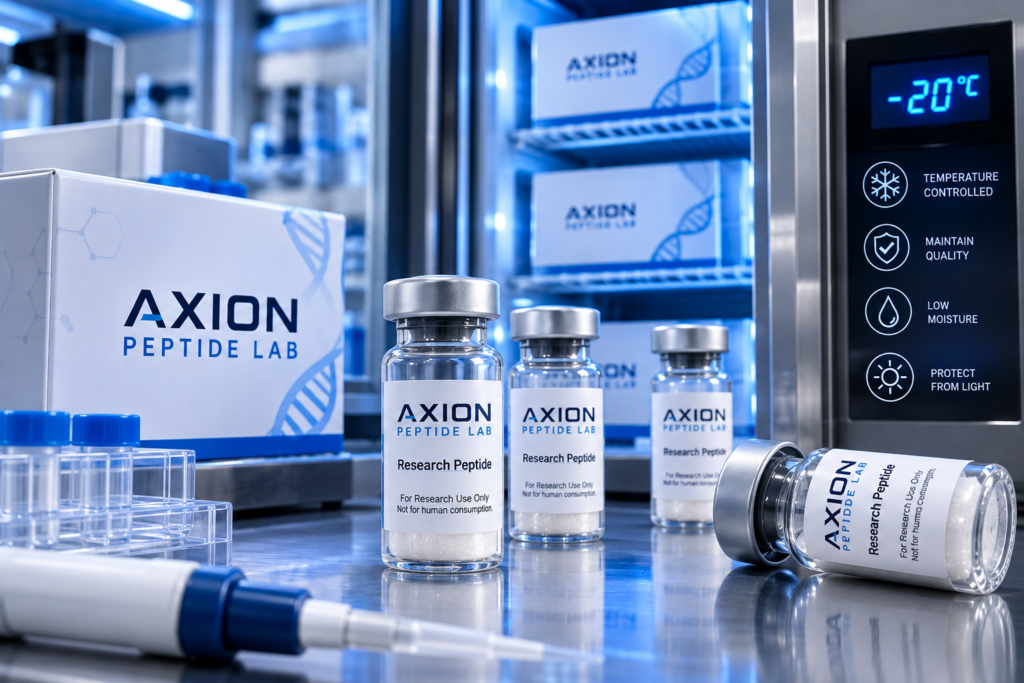
For example, Retava Retatrutide 30mg from Axion Peptide Lab is listed as a research-only peptide product.
Its molecular characterisation would need to account for the actual peptide structure and chemical modifications.
This product example does not establish that a particular batch has been independently verified by the analytical methods discussed here.
Modified Peptide Structures
Some synthetic peptides contain chemical modifications that influence their molecular mass.
For such materials, the theoretical mass must include the complete intended chemical structure.
Multi-Component Preparations
A mixture containing several peptides may require separate identification of its individual constituents. peptide molecular weight analysis
A single intact mass result does not establish the composition of the entire mixture. peptide molecular weight analysis
Supplier Documentation
Where available, a Certificate of Analysis may provide mass spectrometric information.
Laboratories should verify whether the document corresponds to the actual product batch and whether the analytical method supports the stated conclusions.
12. Molecular Weight Analysis Versus Peptide Purity Testing
Molecular mass verification and chromatographic purity testing address different questions.
Molecular mass analysis investigates whether detected ions are consistent with an expected molecular structure.
Chromatographic purity testing evaluates the distribution of detected components under a defined analytical method.
Identity and Purity Are Not Interchangeable
A preparation may contain a dominant chromatographic peak whose molecular identity has not been established.
Conversely, a sample may contain the correct peptide alongside significant impurities.
Quantitative Content Is Another Measurement
Neither intact molecular mass nor an uncalibrated chromatographic area percentage automatically establishes the amount of target peptide by weight.
Quantitative analysis may require calibrated methods and suitable reference standards. peptide molecular weight analysis
A Complementary Analytical Approach
For many research applications, laboratories benefit from combining appropriate chromatographic, mass spectrometric and quantitative evidence.
The necessary methods depend on the intended experiment.
13. Common Errors in Peptide Molecular Weight Analysis
Confusing m/z With Neutral Molecular Mass
A multiply charged peptide ion can appear at an m/z value much lower than its neutral molecular mass. peptide molecular weight analysis
Ignoring Charge States
Multiple peaks may originate from the same peptide rather than different compounds.
Comparing Average and Monoisotopic Mass
Theoretical and measured values must be compared on the same mass basis.
Forgetting Chemical Modifications
Terminal modifications and other chemical groups affect the expected molecular mass.
Misinterpreting Adducts
Sodium and other adducts can produce additional signals.
Assuming Intact Mass Confirms Sequence
Different sequences may share the same molecular mass.
Assuming High Mass Accuracy Guarantees Identity
Accurate mass is valuable, but structural isomers can remain indistinguishable.
Ignoring Spectral Quality
Weak signals, overlapping peaks and incorrect assignments can produce misleading conclusions.
Treating Signal Intensity as Absolute Concentration
Ionisation efficiency varies between compounds.
Overlooking Batch Documentation
Analytical evidence should be connected to the actual material being evaluated.
14. Practical Laboratory Checklist for Peptide Identity Analysis
Before interpreting peptide molecular weight analysis results, laboratories can review the following questions.
- Is the intended peptide structure clearly defined?
- Have terminal and other chemical modifications been included?
- Is the theoretical mass calculated on the correct basis?
- Is the measured value reported as m/z or neutral mass?
- Have charge states been assigned correctly?
- Is the instrument appropriately calibrated?
- Is mass accuracy acceptable for the analytical objective?
- Are isotope patterns consistent with the proposed interpretation?
- Have potential adducts and impurities been considered?
- Is additional MS/MS or other structural analysis necessary?
A documented checklist can help make analytical interpretation more consistent.
However, it is not a substitute for a validated or appropriately qualified analytical method.
Frequently Asked Questions
What is peptide molecular weight analysis?
Peptide molecular weight analysis uses analytical methods, particularly mass spectrometry, to determine whether a peptide’s measured molecular mass is consistent with its expected chemical structure.
How does LC-MS identify peptides?
LC-MS combines chromatographic separation with mass spectrometric information. It provides molecular mass evidence that can support peptide identification.
What is the difference between molecular mass and m/z?
Molecular mass describes the mass of a molecule. Mass-to-charge ratio describes the measured mass of an ion divided by its charge number.
Why does one peptide produce several mass spectrometry peaks?
Electrospray ionisation can generate multiple charge states and isotopic peaks associated with the same peptide.
What is deconvolution in peptide mass spectrometry?
Deconvolution interprets charged-ion signals to estimate the neutral molecular mass.
What is monoisotopic mass?
Monoisotopic mass is calculated using the exact masses of the most abundant isotopes of the elements in a molecule.
Can LC-MS confirm the complete amino acid sequence?
Intact LC-MS does not necessarily confirm the complete sequence. Tandem mass spectrometry or other methods may provide additional structural evidence.
What does mass accuracy in ppm mean?
It describes the difference between measured and theoretical mass relative to the theoretical value, expressed in parts per million.
Can mass spectrometry detect peptide degradation?
It can help detect certain chemical changes, particularly when degradation products have different masses.
Does a correct molecular mass guarantee peptide purity?
No. Molecular identity and chromatographic purity are separate analytical characteristics.
Conclusion
Peptide molecular weight analysis is a powerful approach to investigating the chemical identity of synthetic research peptides.
Electrospray ionisation allows peptides to generate charged ions that can be detected by mass spectrometry.
Charge-state interpretation and deconvolution enable analysts to estimate neutral molecular mass.
High-resolution instruments provide accurate mass measurements that can support molecular formula assessment and impurity investigations.
However, correct intact mass does not automatically establish the complete amino acid sequence, stereochemistry or purity of a sample.
Tandem mass spectrometry and other complementary analytical techniques may be required for more detailed structural confirmation.
For laboratories evaluating research materials, the most reliable approach is to interpret molecular mass data alongside chromatographic findings, relevant documentation and the intended scientific application.
Molecular mass agreement provides valuable identity evidence, but reliable peptide characterisation depends on understanding what that evidence can—and cannot—establish.
Scientific References
- Electrospray Ionization Mass Spectrometry: A Technique to Access the Information beyond the Molecular Weight of the Analyte. https://pmc.ncbi.nlm.nih.gov/articles/PMC3348530/
- Principles of Electrospray Ionization. https://pmc.ncbi.nlm.nih.gov/articles/PMC3134074/
- Accurate Mass Measurements in Proteomics. https://pmc.ncbi.nlm.nih.gov/articles/PMC2713049/
- Verification of Automated Peptide Identifications from Proteomic Tandem Mass Spectra. https://pmc.ncbi.nlm.nih.gov/articles/PMC2819013/
- Mass Spectrometry for Proteomics. NCBI Bookshelf. https://www.ncbi.nlm.nih.gov/books/NBK56011/
- Peptide Sequence Analysis. Methods in Enzymology. https://doi.org/10.1016/S0076-6879(05)02007-0
Editorial disclosure: This article includes a contextual link to an Axion Peptide Lab research product. Product availability and catalogue descriptions do not independently establish the analytical quality of a particular batch.