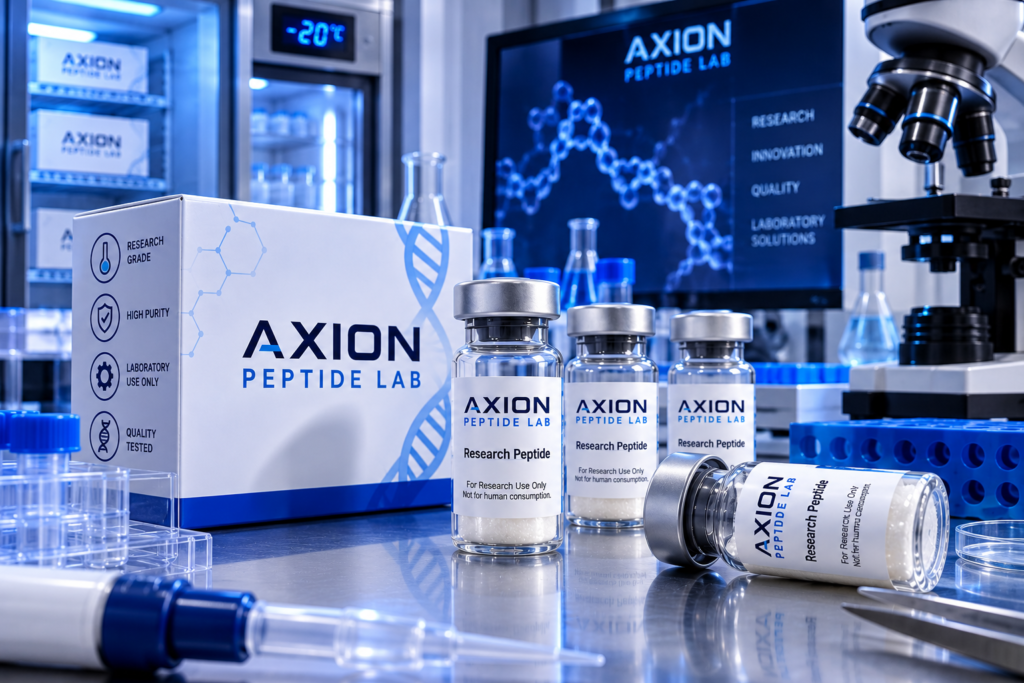
Peptide stability testing is an essential component of laboratory research involving synthetic peptides, peptide-based reference materials and experimental molecular compounds. Although peptide purity and identity are important during initial material characterisation, they do not establish whether a sample will retain its original chemical and physical properties throughout storage and experimental handling. peptide stability testing
A peptide may satisfy its analytical specifications when first prepared but subsequently undergo oxidation, hydrolysis, deamidation, aggregation or other changes.
These transformations can affect experimental measurements, alter molecular characteristics and introduce uncertainty into scientific investigations.
For laboratories working with peptide materials, understanding stability is therefore just as important as confirming initial purity.
This guide examines nine major factors influencing peptide stability, the analytical methods used to investigate degradation and the differences between lyophilised and solution-based preparations.
It also explains why storage recommendations must be based on the specific compound rather than a universal temperature rule.
Research-use notice: This article concerns laboratory materials and analytical research. Research-use-only peptides are not intended for human or veterinary administration. Stability information does not establish clinical safety, efficacy or regulatory approval. peptide stability testing
What Is Peptide Stability Testing?
Peptide stability testing involves examining whether a peptide preparation maintains defined chemical and physical characteristics under specified environmental conditions over time.
The purpose is to detect changes that may affect the material’s suitability for its intended scientific application.
Depending on the peptide and research objective, relevant characteristics may include molecular identity, chromatographic purity, quantitative content, degradation products, aggregation, solubility and physical appearance.
Chemical Stability
Chemical stability concerns the preservation of the peptide’s molecular structure.
Chemical degradation involves changes to covalent bonds or chemical groups.
Examples include oxidation, hydrolysis, deamidation, isomerisation and disulphide exchange.
These reactions can produce new molecular species with different analytical properties. peptide stability testing
Physical Stability
Physical stability concerns changes that do not necessarily require modification of the peptide’s primary chemical structure.
Examples include aggregation, precipitation, adsorption to container surfaces and changes in solubility.
Physical changes can affect experimental measurements even when the peptide’s molecular mass remains unchanged.
Why Stability Matters for Reproducibility
Scientific experiments depend on controlled variables.
If a peptide changes during storage, its measured concentration or impurity profile may differ between experiments.
Without appropriate stability information, researchers may incorrectly attribute differences in results to experimental conditions rather than changes in the starting material. peptide stability testing
Peptide stability testing helps laboratories identify and manage this uncertainty.
1. Temperature and Peptide Stability
Temperature is one of the most important environmental variables affecting peptide stability.
Many chemical reactions proceed more rapidly at elevated temperatures.
However, the relationship between temperature and degradation is not identical for every peptide.
The effect depends on molecular structure, formulation, physical state and the degradation mechanism involved.
Elevated Temperatures
Increased temperature can accelerate certain chemical reactions, including hydrolysis, oxidation and deamidation.
It may also influence physical processes such as aggregation.
The extent of these changes depends on the compound and experimental conditions. peptide stability testing
A peptide that remains chemically stable under one temperature condition may behave differently under another.
Refrigerated Storage
Refrigeration can reduce the rates of some degradation processes.
Nevertheless, refrigerated storage does not guarantee stability.
Some peptides may still undergo measurable chemical or physical changes at low temperatures.
Others may experience solubility or aggregation problems under particular conditions.
Frozen Storage
Freezing may be appropriate for certain peptide preparations, particularly when supported by product-specific stability data.
However, freezing is not universally beneficial.
Ice formation, concentration changes in unfrozen regions and subsequent thawing can influence the stability of some formulations.
Why There Is No Universal Storage Temperature
The correct storage condition depends on the specific peptide and its preparation.
Laboratories should distinguish between general guidance, supplier recommendations and storage conditions established through actual stability studies.
A temperature commonly used for one research peptide should not automatically be applied to another.
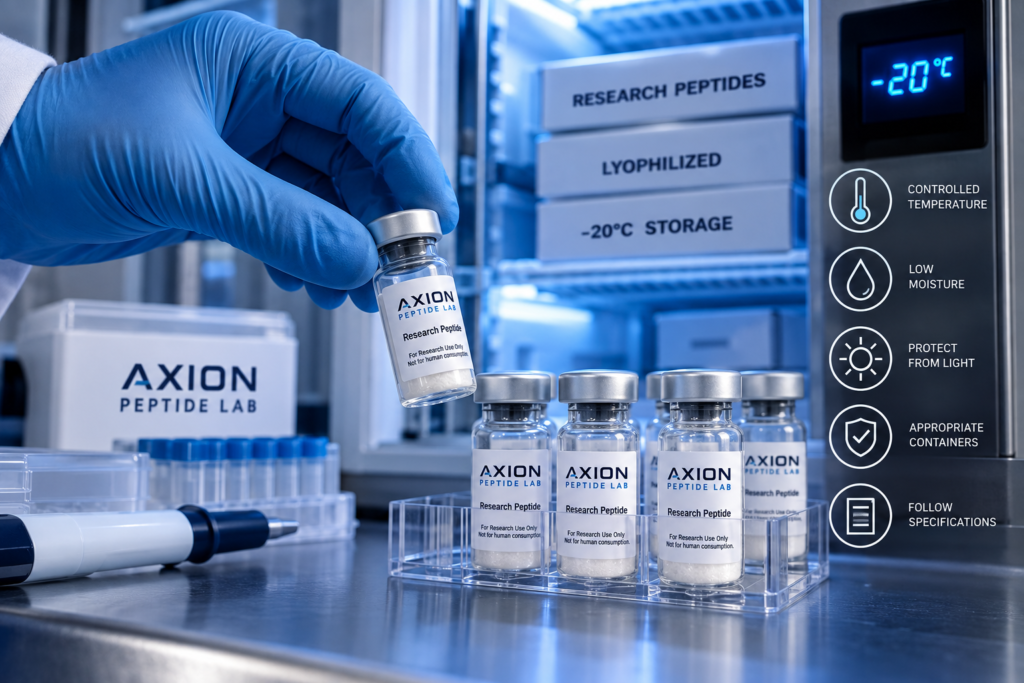
2. Moisture and Lyophilised Peptide Stability
Lyophilisation, also called freeze-drying, is widely used to produce solid peptide preparations.
The process generally involves freezing a solution and removing water through controlled drying.
Reducing the amount of water can improve the stability of some materials by limiting certain degradation reactions.
However, lyophilised peptides are not necessarily completely dry or indefinitely stable.
Residual Moisture
A lyophilised preparation may retain measurable residual water.
The amount of water can depend on the formulation, processing conditions and packaging. peptide stability testing
Residual moisture may influence chemical reactions and the physical properties of the dried material.
Moisture Absorption
Some dried materials can absorb moisture from the surrounding atmosphere.
This may affect their physical state and chemical stability.
The significance depends on the peptide and formulation.
Solid-State Degradation
Chemical reactions can occur even when a peptide is stored in solid form.
Potential pathways include oxidation, deamidation and other transformations.
Therefore, lyophilisation should not be interpreted as a guarantee against degradation.
Analytical Moisture Testing
Karl Fischer titration is one established method for determining water content.
Other approaches may be appropriate depending on the material and analytical objective.
A conventional HPLC purity percentage does not independently establish residual moisture content.
Packaging Considerations
Packaging can influence exposure to environmental moisture.
Container integrity and compatibility should therefore be considered during storage studies.
3. Oxidation and Peptide Degradation
Oxidation is an important chemical degradation pathway for certain peptides. peptide stability testing
Its likelihood depends on amino acid composition, molecular environment and exposure to oxidising conditions.
Oxidation-Susceptible Residues
Methionine, cysteine and tryptophan are among the residues associated with oxidative transformations.
Other residues may also be affected under particular conditions.
Methionine Oxidation
Methionine can undergo oxidation to form methionine sulfoxide.
This transformation introduces an oxygen atom and changes the molecular mass.
Mass spectrometry may therefore provide useful evidence for identifying the modification.
However, the presence and extent of oxidation require actual analytical measurement.
Cysteine and Disulphide Chemistry
Cysteine residues contain sulphur-containing groups that can participate in oxidation and disulphide bond formation.
In peptides containing disulphide bonds, inappropriate bond rearrangement may alter molecular characteristics.
Factors Affecting Oxidation
Oxidation may be influenced by oxygen exposure, light, reactive impurities, metal ions, pH and temperature.
The relative importance of these factors is compound-specific.
Detecting Oxidation Products
Suitable HPLC and LC-MS methods may help detect oxidation-related changes.
For example, a new chromatographic peak accompanied by an expected molecular-mass difference may support investigation of an oxidised derivative.
Further characterisation may be needed to establish its structure.
4. Hydrolysis and Peptide Bond Cleavage
Hydrolysis involves chemical reactions in which water participates in bond cleavage.
Peptide bonds can undergo hydrolytic degradation under suitable conditions.
The likelihood and rate depend on the peptide sequence and surrounding environment.
The Role of pH
Acidic or alkaline conditions may accelerate particular hydrolytic reactions.
However, different peptide sequences exhibit different susceptibilities.
A pH condition that improves the stability of one compound may not be suitable for another.
Temperature and Hydrolysis
Higher temperatures can accelerate some hydrolytic processes.
This makes temperature an important variable in experimental stability investigations.
Sequence-Specific Susceptibility
Certain amino acid arrangements may be particularly susceptible to chemical cleavage.
Researchers may therefore examine the sequence when identifying plausible degradation pathways.
Detecting Cleavage Products
Hydrolysis can produce shorter peptide fragments.
These may have different chromatographic retention times and molecular masses.
HPLC and mass spectrometry can help investigate the resulting products.
Why Hydrolysis Matters
A peptide preparation can gradually develop additional molecular species during storage. peptide stability testing
If these changes are not recognised, the composition of material used in an experiment may differ from the original specification.
5. Deamidation and Isomerisation
Deamidation and isomerisation are important degradation pathways for certain peptide sequences.
They can alter chemical properties without necessarily causing complete peptide-chain cleavage.
Deamidation
Deamidation commonly involves susceptible asparagine or glutamine residues.
The reaction changes the chemical structure of the relevant side chain.
Its rate depends on factors including sequence, pH and temperature.
Isomerisation
Isomerisation can produce molecules with the same overall elemental composition but different structural arrangements.
For example, aspartate-related isomerisation may affect the peptide backbone.
Analytical Challenges
Some isomeric products have identical molecular masses.
Consequently, intact mass spectrometry alone may not distinguish them.
Chromatographic separation and additional structural methods may be necessary. peptide stability testing
Experimental Implications
Chemical modifications can change molecular properties.
Whether these changes meaningfully affect a particular experiment depends on the peptide and research model.
Their presence should be evaluated rather than automatically assumed to produce a specific biological effect.
6. pH, Buffer Composition and Peptide Stability
The pH of a peptide solution can influence both chemical and physical stability.
Changes in pH may alter peptide charge, solubility and the rates of certain degradation reactions.
Ionisation and Molecular Charge
Peptides contain functional groups that can gain or lose protons depending on pH.
These changes influence their net charge and interactions with the surrounding solution.
Buffer Selection
Buffers help maintain a relatively consistent pH.
However, different buffer systems can influence stability in different ways.
The selection of a buffer should reflect the chemical properties of the peptide and the objectives of the experiment.
Buffer Concentration
Ionic strength and buffer concentration can affect peptide interactions and physical behaviour.
They may influence aggregation or solubility under particular conditions. peptide stability testing
Why One Buffer Does Not Fit Every Peptide
There is no universally optimal buffer for all peptide materials.
A formulation appropriate for one compound may promote degradation or precipitation in another.
Laboratory stability studies should therefore evaluate the actual formulation rather than relying on a generic recommendation.
7. Light Exposure and Photochemical Degradation
Light can contribute to degradation in certain peptide systems.
The significance depends on the wavelength, intensity, exposure duration and molecular characteristics of the material.
Light-Sensitive Amino Acid Residues
Some aromatic amino acid residues may participate in photochemical reactions.
Tryptophan-containing peptides are among those that may be susceptible under appropriate conditions.
Indirect Oxidative Effects
Light exposure can also contribute to oxidative processes in some formulations.
The presence of photosensitive components or impurities may influence these reactions.
Packaging and Protection
Light-protective packaging may be appropriate for materials with demonstrated photosensitivity.
However, not every peptide requires identical protection.
Photostability Studies
A photostability investigation evaluates whether defined light exposure produces measurable changes in the material.
Analytical methods may examine changes in purity, identity, degradation products or physical characteristics.
The study design should reflect the scientific purpose.
8. Aggregation, Adsorption and Physical Instability
Peptide stability testing should not focus exclusively on chemical degradation. peptide stability testing
Physical instability can also affect laboratory measurements. peptide stability testing
Aggregation
Aggregation occurs when peptide molecules associate to form larger assemblies.
Depending on the peptide, these assemblies may be reversible or irreversible.
Some peptides may form ordered fibrillar structures, while others form less organised aggregates.
Factors Influencing Aggregation
Aggregation behaviour can depend on concentration, pH, ionic strength, temperature, agitation and molecular sequence.
Impurities and container surfaces may also influence the process.
Precipitation
A peptide may become less soluble under certain conditions and form visible or microscopic precipitates.
Precipitation can reduce the amount of material remaining in solution.
Surface Adsorption
Some peptides can adsorb to laboratory container surfaces.
This may reduce the measurable concentration of peptide in solution without necessarily producing a chemically degraded molecule. peptide stability testing
Why Physical Stability Matters
A sample can appear chemically intact by one analytical method while experiencing concentration loss or aggregation.
For this reason, stability investigations may require complementary physical and chemical measurements.
9. Freeze–Thaw Cycles and Repeated Sample Handling
Repeated freezing and thawing can influence certain peptide preparations.
However, the effect varies according to the peptide, concentration, formulation and experimental conditions.
Freezing-Induced Changes
During freezing, ice formation can alter the composition of the remaining liquid phase.
This may create local changes in concentration, ionic strength or pH.
Such changes can affect some peptide systems. peptide stability testing
Thawing
Thawing introduces another period of changing temperature and physical conditions.
Depending on the formulation, this may influence aggregation or other stability characteristics.
Repeated Handling
Repeated opening, transferring and sampling can introduce additional variables.
These may include moisture exposure, concentration changes or contamination.
Aliquoting in Laboratory Workflows
Where appropriate for the research protocol, dividing material into separately identified aliquots can reduce repeated handling of a common stock.
However, aliquoting does not guarantee stability.
The selected storage and handling procedures should be supported by the material’s characteristics and relevant experimental evidence. peptide stability testing
Lyophilised Peptides vs Peptide Solutions: Which Is More Stable?
Lyophilised and solution-based preparations have different stability considerations.
In many cases, reducing water content can improve the stability of susceptible compounds.
However, this is not a universal rule. peptide stability testing
| Characteristic | Lyophilised preparation | Solution preparation |
|---|---|---|
| Water content | Reduced but not necessarily absent | Water present in aqueous systems |
| Hydrolytic reactions | May be reduced | Can occur depending on conditions |
| Moisture exposure | Relevant during storage and handling | Already contains solvent |
| pH effects | May involve residual or local environments | Directly influenced by solution pH |
| Aggregation | Possible | Possible |
| Oxidation | Possible | Possible |
| Stability testing | Solid-state methods may be needed | Solution-specific methods may be needed |
A comparison should therefore consider the actual peptide and formulation.
It is scientifically inappropriate to assign a universal shelf life to all lyophilised peptides or all peptide solutions.
How Laboratories Measure Peptide Stability
A suitable peptide stability testing programme uses analytical methods capable of detecting relevant changes.
Stability-Indicating HPLC
A stability-indicating chromatographic method should distinguish the intended peptide from important degradation products.
This may involve evaluating chromatographic resolution, specificity and changes over time. peptide stability testing
LC-MS Analysis
LC-MS can help investigate changes in molecular mass and identify certain degradation products.
However, ionisation differences and structural isomers can limit interpretation.
Quantitative Peptide Content
A suitable quantitative assay can determine whether the amount of target peptide changes during storage.
Water Content Analysis
Moisture testing may be particularly relevant for lyophilised preparations. peptide stability testing
Physical Characterisation
Depending on the material, laboratories may assess aggregation, precipitation, particle formation or solubility.
Visual Examination
Changes in appearance may provide useful observations.
However, the absence of visible changes does not establish chemical stability.
Complementary Analytical Evidence
No single technique necessarily measures every relevant degradation pathway. peptide stability testing
The analytical strategy should be selected according to the material and the intended scientific application.
Accelerated Stability Testing vs Real-Time Stability Testing
Stability studies can be conducted under different environmental conditions.
Real-Time Stability Studies
Real-time studies evaluate material changes under defined storage conditions over a specified period.
They can provide evidence about behaviour under the conditions actually being investigated. peptide stability testing
Accelerated Stability Studies
Accelerated studies use conditions intended to increase the rate of relevant changes.
These may include elevated temperatures or other stress conditions.
Such studies can help identify potential degradation pathways and compare formulations.
Limitations of Accelerated Studies
Accelerated results cannot always be extrapolated directly to normal storage conditions.
Different degradation pathways may become dominant under different stresses.
For example, elevated temperature might accelerate a reaction that is not the principal degradation pathway under refrigerated conditions.
Forced Degradation Studies
Forced degradation studies deliberately expose materials to stress conditions to investigate degradation behaviour and analytical method specificity.
These studies are useful for method development.
However, forced degradation results should not automatically be interpreted as predictions of ordinary shelf life.
Peptide Stability Testing and Shelf-Life Claims
Shelf life describes a period during which a material is expected to remain within defined specifications under stated conditions.
A scientifically supported shelf-life claim requires relevant evidence. peptide stability testing
Defining Specifications
The first step is identifying the quality attributes that must remain acceptable.
These may include identity, content, impurity limits or physical characteristics.
Establishing Storage Conditions
The claim must relate to defined environmental conditions.
Monitoring Changes Over Time
Appropriate analytical measurements are used to investigate whether the material continues to meet its specifications.
Avoiding Unsupported Claims
Statements such as “stable for years” or “stable for 30 days after preparation” should not be applied universally.
The actual duration depends on the compound, formulation, container and storage conditions.
A general literature observation does not establish the shelf life of a specific commercial batch. peptide stability testing
Research Product Examples: Why Stability Must Be Compound-Specific
Research suppliers offer materials with different molecular structures and formulations.
These differences are relevant when designing stability investigations.
Retatrutide Research Materials
Axion Peptide Lab lists Alluvi Retatrutide 20mg among its laboratory research products.
For a peptide of this type, researchers investigating stability would need to consider its specific molecular structure, formulation and potential degradation pathways.
A generic peptide storage recommendation would not establish product-specific shelf life.
Multi-Component Peptide Blends
The Alluvi Glow GHK-Cu, BPC-157 and TB-500 70mg research blend provides an example of a multi-component research material.
Mixtures may introduce additional stability questions because individual constituents can have different chemical characteristics.
The stability of each isolated component does not automatically establish the stability of the combined preparation.
Tirzepatide Research Materials
Axion also lists Alluvi Tirzepatide 20mg for research applications.
Laboratory investigations involving peptide analogues should distinguish the stability of a specific molecular structure from assumptions based on other compounds in the same broad research category.
These catalogue examples illustrate different material-selection considerations. They do not establish verified storage durations, batch stability results or suitability for administration.
Building a Peptide Stability Testing Programme
A structured programme begins with the research question.
The laboratory should identify which material characteristics are relevant and what changes would compromise the intended application.
Step 1: Establish Initial Characterisation
Record the starting analytical characteristics of the material.
These may include identity, chromatographic purity, content and other relevant attributes.
Step 2: Define the Storage Conditions
Select conditions appropriate to the scientific objective.
These should be documented clearly.
Step 3: Identify Relevant Degradation Pathways
Consider the peptide sequence, formulation and known chemical vulnerabilities.
Step 4: Select Analytical Methods
Choose methods capable of detecting the changes that matter.
Step 5: Establish Sampling Intervals
The sampling schedule should be appropriate to the expected stability behaviour and experimental purpose.
Step 6: Evaluate Physical Changes
Where relevant, include solubility, aggregation or other physical measurements.
Step 7: Compare Results With Baseline Data
Assess changes relative to the initial analytical findings.
Step 8: Document Uncertainty
Recognise limitations in analytical sensitivity, sample preparation and method performance.
Step 9: Interpret the Results Within the Study Conditions
Avoid extending conclusions beyond the material and conditions actually investigated.

Common Mistakes in Peptide Stability Research
Assuming High Purity Means Long Shelf Life
Initial chromatographic purity does not establish how rapidly a peptide may degrade. peptide stability testing
Treating All Peptides as Chemically Identical
Different sequences and modifications can produce different stability characteristics.
Assuming Lyophilisation Prevents Every Degradation Reaction
Solid-state reactions can still occur.
Using HPLC Alone for Every Stability Question
Some changes may require complementary analytical techniques.
Ignoring Physical Instability
Aggregation, precipitation and adsorption may affect experimental measurements.
Extrapolating Accelerated Results Without Evidence
Stress conditions can alter degradation mechanisms.
Applying General Storage Guidance to Specific Products
Product-specific conclusions require appropriate supporting data.
Frequently Asked Questions
What is peptide stability testing?
Peptide stability testing evaluates changes in chemical and physical characteristics under defined conditions over time.
What causes peptide degradation?
Potential causes include temperature, moisture, oxidation, hydrolysis, pH changes, light exposure and formulation-related factors. peptide stability testing
Are lyophilised peptides always more stable than solutions?
Not always. Lyophilisation can improve stability for some compounds, but results depend on the peptide and formulation.
Does refrigeration prevent peptide degradation?
No. Refrigeration may slow certain reactions but does not guarantee stability.
Can peptides degrade while frozen?
Yes. Some chemical or physical changes may still occur, depending on the material and conditions.
What is a stability-indicating HPLC method?
It is a chromatographic method demonstrated to distinguish the target material from relevant degradation products.
Can LC-MS identify peptide degradation products?
LC-MS can provide useful molecular-mass evidence, although additional techniques may be required for complete identification. peptide stability testing
How is peptide shelf life established?
Shelf-life claims require appropriate stability evidence under defined conditions and against relevant specifications.
Does 99% peptide purity establish stability?
No. Purity at one point in time does not demonstrate future stability.
Are peptide blends more difficult to evaluate?
They can be, because multiple components may have different degradation pathways and analytical requirements.
Conclusion
Peptide stability testing is an essential part of understanding how research materials behave during storage and laboratory handling.
Temperature, moisture, oxidation, hydrolysis, deamidation, pH, light exposure, aggregation and repeated handling can all influence peptide preparations.
However, the importance of each factor depends on the specific compound and formulation.
Reliable stability assessment therefore requires suitable analytical methods, clearly defined experimental conditions and careful interpretation of the resulting data.
HPLC, LC-MS, quantitative assays and physical characterisation techniques can provide complementary information.
For research laboratories, the central principle is that stability should be demonstrated for the material and conditions being investigated rather than assumed from a generic storage recommendation. peptide stability testing
A peptide’s initial purity describes its condition at the time of analysis; stability testing investigates how that condition changes over time.
Scientific References
- Designing Formulation Strategies for Enhanced Stability of Therapeutic Peptides in Aqueous Solutions: A Review. Pharmaceutics (2023). https://pmc.ncbi.nlm.nih.gov/articles/PMC10056213/
- Strategies for Overcoming Protein and Peptide Instability in Biodegradable Drug Delivery Systems. https://pmc.ncbi.nlm.nih.gov/articles/PMC10526705/
- Factors Affecting the Physical Stability (Aggregation) of Peptide Therapeutics. Interface Focus (2017). https://pmc.ncbi.nlm.nih.gov/articles/PMC5665799/
- Recommendations for the Generation, Quantification, Storage and Handling of Peptides Used for Mass Spectrometry-Based Assays. https://pmc.ncbi.nlm.nih.gov/articles/PMC4830481/
- Solid-State Chemical Stability of Proteins and Peptides. https://pubmed.ncbi.nlm.nih.gov/10229638/
- Regulatory Guidelines for the Analysis of Therapeutic Peptides and Proteins. https://pmc.ncbi.nlm.nih.gov/articles/PMC11806371/
Editorial disclosure: This article contains contextual links to Axion Peptide Lab research products. These links illustrate research-material categories and do not constitute independent verification of individual product stability, batch quality or storage claims.