
Finding reliable research peptide suppliers requires more than comparing product prices, reading customer reviews or choosing a company with an attractive website. For professional laboratories, scientific institutions and qualified research organisations, selecting a supplier is a procurement decision that can directly influence experimental consistency, analytical reliability and laboratory documentation.
Research peptides are used in investigations involving molecular signalling, receptor biology, analytical chemistry, protein interactions and experimental peptide characterisation. However, the quality requirements for these materials vary depending on the specific compound and intended research application. research peptide suppliers
A peptide preparation suitable for preliminary analytical method development may not have the documentation or characterisation required for a more demanding investigation.
That distinction makes supplier evaluation particularly important.
This guide examines nine practical criteria for evaluating research peptide suppliers, including product specifications, analytical documentation, batch traceability, research-use restrictions, packaging, storage information and purchasing transparency.
It also explains how to compare laboratory research products without confusing supplier marketing statements with independently established analytical results.
Research-use notice: This article concerns laboratory procurement and scientific materials. Research-use-only products are not intended for human or veterinary administration. Analytical purity does not establish clinical safety, therapeutic effectiveness or regulatory approval. research peptide suppliers
Why Research Peptide Supplier Selection Matters
Research peptide suppliers occupy an important position in the scientific supply chain.
Laboratories depend on external suppliers for materials that may be used in analytical experiments, receptor studies, chemical investigations and method-development projects.
When a laboratory receives a research peptide, it needs to know what material has been supplied, how it is identified and whether the available information supports the intended experiment.
A product name alone is not sufficient.
Two suppliers may list a compound with the same nominal identity while offering different quantities, formulations, documentation packages or packaging formats. research peptide suppliers
Even products bearing identical names may originate from different manufacturing batches.
This can introduce uncertainty when researchers attempt to reproduce experimental conditions.
The goal of supplier evaluation is therefore not simply to identify the cheapest source.
It is to determine whether the supplier can provide a material that meets the laboratory’s defined scientific and operational requirements.
1. Verify the Supplier’s Research Product Catalogue
The first step in evaluating research peptide suppliers is reviewing the actual product catalogue.
A useful catalogue should clearly distinguish individual compounds, mixtures, different quantities and product formats.
Laboratories should be able to identify what they are considering without relying on vague descriptions. research peptide suppliers
Product Identification
A research product listing should provide an unambiguous product name.
Where applicable, additional information may include the molecular formula, molecular mass, amino acid sequence, salt form or other relevant chemical identifiers.
The appropriate level of detail depends on the material.
For example, a synthetic peptide requires different structural documentation from a non-peptide biochemical compound.
Product Quantity
A stated product quantity is important for inventory planning, but it does not independently establish analytical content.
A product described as containing 20 mg should not automatically be assumed to contain 20 mg of analytically verified target compound on a dry, counterion-free basis.
Laboratories may need to distinguish nominal quantity, net fill, peptide content and chromatographic purity.
Product Format
Research materials may be supplied in different physical presentations.
These can include lyophilised powders, solutions and other laboratory formats.
The physical presentation can influence storage requirements, stability considerations and analytical preparation.
Researchers should confirm the actual formulation before designing experiments.
Example of a Research Product Listing
Axion Peptide Lab maintains a catalogue of laboratory research materials, including Alluvi Retatrutide 20mg (R&D).
Its product listing identifies the compound, nominal quantity and research-only intended purpose.
This provides a practical example of the type of basic product information that procurement teams can review.
However, laboratories should separately verify any analytical characteristics required for their intended work.
A clearly presented product listing is useful, but it is not a substitute for batch-specific analytical evidence. research peptide suppliers

2. Examine Certificates of Analysis and Supporting Documentation
A Certificate of Analysis, or COA, is one of the most important documents in research-material procurement.
A COA reports specified analytical results associated with a material or production batch.
However, not all certificates contain the same information. research peptide suppliers
What Should a COA Include?
Depending on the material and testing programme, a COA may contain:
- Product identification.
- Batch or lot number.
- Analytical methods.
- Test results.
- Relevant acceptance criteria.
- Testing dates.
- Testing laboratory information.
- Authorisation or review information.
Some certificates also include chromatograms, mass spectra or references to supporting analytical records.
Batch-Specific Documentation
The certificate should correspond to the material actually supplied.
A document from a previous batch does not automatically establish the quality of a new batch.
For this reason, batch identification is essential.
Independent Testing
Independent laboratory testing may provide additional assurance when the testing organisation, methods and results can be verified.
Nevertheless, a document described as third-party testing should not be accepted solely because it carries a laboratory logo.
The underlying analytical information matters.
Understanding Documentation Limitations
A COA reporting chromatographic purity does not necessarily establish sterility, endotoxin status, quantitative content or suitability for administration.
These are different quality attributes.
The European Medicines Agency’s guideline on synthetic peptide development discusses the importance of analytical identification, impurity assessment and complementary methods. research peptide suppliers
Although the guideline concerns medicinal product development rather than ordinary research-material procurement, its analytical principles help explain why peptide characterisation requires more than a single result.
Scientific reference: EMA — Guideline on the Development and Manufacture of Synthetic Peptides.
3. Understand Purity Testing Before Comparing Suppliers
Many research peptide suppliers advertise high purity percentages.
These figures may be relevant, but they require interpretation.
High-performance liquid chromatography is frequently used to investigate peptide purity.
HPLC separates sample constituents according to their chromatographic behaviour.
The resulting chromatogram may show a principal peak associated with the intended compound and additional peaks associated with detected impurities.
What Does 99% Purity Mean?
A reported 99% HPLC area purity generally means that the principal peak accounts for approximately 99% of the included integrated detector response under the specified method.
It does not automatically mean that 99% of the sample’s total mass consists of the target peptide.
Residual moisture, counterions and certain other constituents may not be represented proportionally in the chromatographic result.
Why Analytical Methods Matter
Different methods can produce different results.
Factors influencing interpretation include:
- Detector response.
- Chromatographic resolution.
- Co-eluting components.
- Sample preparation.
- Integration parameters.
- Method specificity.
A numerical purity claim becomes more meaningful when the supplier identifies the analytical method and provides suitable supporting information. research peptide suppliers
Identity Is a Separate Question
A chromatographic purity result does not independently establish the complete molecular identity of a peptide.
Mass spectrometry, peptide mapping and other complementary techniques may be appropriate.
The exact combination depends on the scientific objective and structural complexity of the material.
[INSERT IMAGE 2 HERE]
4. Compare Individual Compounds With Research Blends
Research peptide suppliers may offer individual compounds as well as products containing multiple components.
These products require different procurement considerations.
Individual Research Compounds
For a single-compound material, the laboratory may need to establish the identity, purity and quantitative content of the specified substance.
The relevant analytical strategy depends on the compound’s characteristics.
Multi-Component Research Materials
A blend introduces additional questions.
Researchers may need to establish the identity and amount of each component.
A single chromatographic result does not necessarily confirm the composition or quantity of every constituent in a mixture.
Different compounds may also exhibit different stability characteristics.
Why Composition Matters
Consider a hypothetical three-component research preparation.
A laboratory may need to investigate whether all three intended compounds are present, whether the component ratios meet the relevant specifications and whether additional impurities are detectable.
A label listing three ingredients is not itself evidence of those analytical characteristics.
Example of a Multi-Component Product
Axion Peptide Lab lists Alluvi Glow GHK-Cu, BPC-157 and TB-500 70mg as a research-only product.
This illustrates the distinction between a multi-component product listing and an individual research compound.
For any such material, laboratories should review the actual composition, batch documentation and suitability of the available analytical methods before use.
Research findings concerning individual compounds should not automatically be extrapolated to mixtures.
Similarly, a mixture should not be assumed to possess the same stability or analytical properties as its separate constituents.
5. Assess Batch Traceability and Product Consistency
Batch traceability is a central consideration when comparing research peptide suppliers. research peptide suppliers
A batch or lot number allows a material to be connected with relevant procurement and analytical records.
This is particularly important for laboratories conducting experiments over extended periods.
Why Batch Numbers Matter
Different batches can have different analytical characteristics.
These may include variations in residual moisture, impurity profiles or other measurable properties.
Such differences do not necessarily indicate that a material is unacceptable. research peptide suppliers
Their significance depends on the established specifications and the intended experiment.
Maintaining Laboratory Records
Research organisations may record:
- Supplier identity.
- Product name.
- Catalogue reference.
- Batch or lot number.
- Date received.
- Available analytical documentation.
- Storage conditions.
- Internal inventory reference.
This information helps laboratories reconstruct the material history associated with an experiment.
Batch Consistency and Reproducibility
Reproducibility depends on many factors, including experimental design, instrumentation, sample preparation and biological variability.
Material consistency is one additional consideration.
If a laboratory changes suppliers or batches during a project, retaining accurate records can help identify possible sources of experimental variation. research peptide suppliers
Documentation Should Match the Actual Material
A supplier may provide general product information that applies across its catalogue. research peptide suppliers
However, laboratories should distinguish general statements from results established for a particular batch.
Claims such as independently tested or high purity should be evaluated against the actual documentation available.
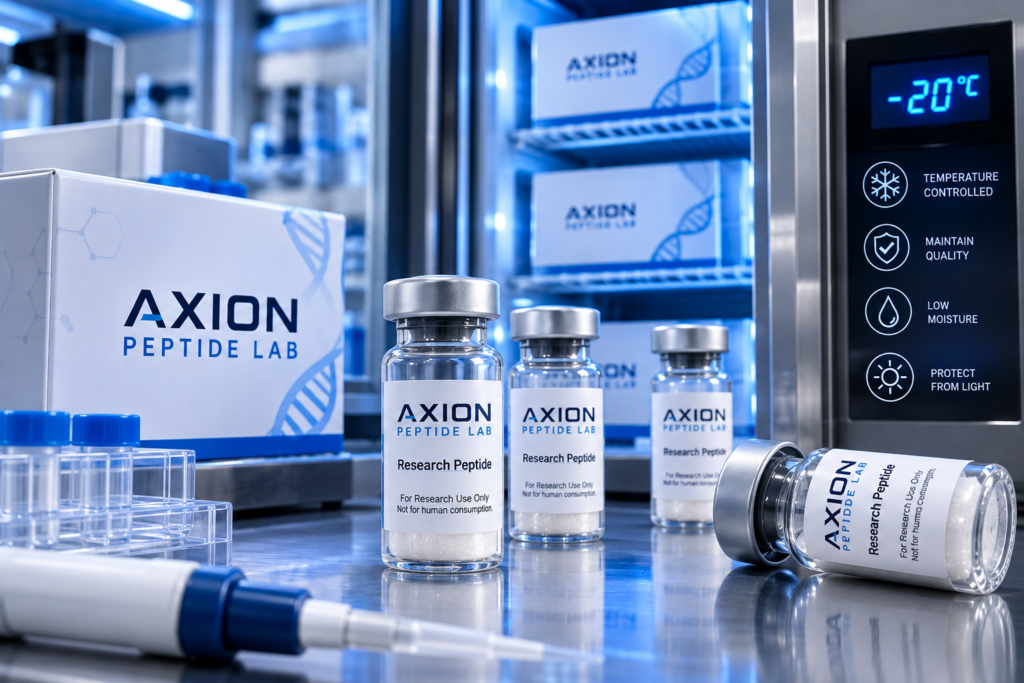
6. Evaluate Storage, Packaging and Shipping Information
Supplier evaluation continues beyond analytical testing.
Packaging, handling and transportation can influence the condition of materials received by a laboratory.
Appropriate Packaging
Research materials should be packaged in a manner consistent with their physical and chemical characteristics.
Relevant considerations may include container compatibility, protection against damage, identification and prevention of contamination.
Temperature Requirements
Storage requirements are compound-specific.
Some materials may require refrigeration or freezing, while others may have different validated storage conditions.
It is inappropriate to assume that all research peptides should be stored identically.
Light and Moisture Exposure
Certain materials may be sensitive to light, moisture or oxygen.
The importance of these factors depends on the compound, formulation and packaging.
Suppliers should provide handling information appropriate to the actual product. research peptide suppliers
Shipping Conditions
Laboratories may need to consider the duration and conditions of transport.
However, a shipping claim should not be interpreted as evidence that a product maintained its specified characteristics throughout transportation unless suitable supporting information is available. research peptide suppliers
Receiving Procedures
A structured laboratory receiving process can include checking the product identity, packaging condition, batch details and accompanying documentation.
Any discrepancies should be investigated before the material enters an experimental workflow.
7. Review Product Specifications Against Experimental Requirements
A common procurement mistake is selecting a research material before defining the requirements of the experiment.
The correct approach begins with the scientific objective.
Analytical Method Development
A laboratory developing a chromatographic method may require material with appropriate identity information and an impurity profile suitable for the intended investigation.
Molecular Biology Research
Studies involving molecular interactions may require particular chemical structures or formulations.
The significance of purity and other attributes depends on the experimental model. research peptide suppliers
Quantitative Biochemical Research
For quantitative studies, accurate content measurements and suitable reference materials may be important.
Nominal product quantity alone may not be sufficient.
Stability Investigations
A laboratory studying degradation may need access to relevant baseline analytical results and methods capable of distinguishing the target material from degradation products.
Comparing Different Chemical Materials
Not every research product listed by a peptide supplier is necessarily a peptide.
For example, NAD+ is a nucleotide-derived coenzyme rather than a peptide.
Axion Peptide Lab offers Alluvi NAD+ 1000mg for laboratory research.
Its inclusion in a research supplier’s catalogue illustrates why laboratories must evaluate the chemical identity and analytical requirements of each material individually.
Methods suitable for a synthetic peptide may not be directly transferable to NAD+.
The scientific characteristics of the compound should determine the analytical strategy.
8. Check Supplier Transparency and Purchasing Information
Research peptide suppliers should provide clear information about their products and purchasing processes.
Transparency helps procurement teams evaluate whether a supplier meets organisational requirements.
Product Descriptions
Descriptions should distinguish verified technical specifications from general promotional statements.
They should also identify the intended purpose of the product.
Research-Use Restrictions
Laboratory research products should not be represented as approved medicines merely because they are commercially available.
The intended use should be clear. research peptide suppliers
Purchasing Documentation
Depending on institutional requirements, laboratories may need invoices, order confirmations, supplier details and relevant shipping documentation.
Customer Support
A supplier’s ability to respond to technical questions can be useful.
However, helpful customer service is not a replacement for reliable analytical evidence.
Price Transparency
Price is an important purchasing consideration, but it should be evaluated alongside quantity, documentation and the intended application.
A lower-priced material may not represent better value if it lacks information necessary for the experiment.
Equally, a higher price does not independently establish superior analytical quality. research peptide suppliers
Supplier Claims
Marketing language should be treated separately from scientific evidence.
Terms such as premium, laboratory grade and high purity require appropriate context.
The most meaningful claims are those supported by relevant documentation.
9. Establish a Consistent Research Supplier Evaluation Process
A repeatable procurement framework can improve consistency when laboratories compare research peptide suppliers.
The process should be proportionate to the material and experimental requirements.
Define the Required Material
Identify the exact compound, relevant chemical characteristics and required format.
Establish Acceptance Criteria
Determine which quality attributes are necessary for the intended experiment.
Review Available Documentation
Examine product specifications, COAs and other relevant records.
Confirm Traceability
Check that the available documentation can be associated with the actual material supplied.
Evaluate Handling Requirements
Review packaging, storage and transportation considerations.
Confirm Regulatory and Institutional Suitability
Ensure that procurement and use are consistent with applicable laws and institutional policies.
Document the Decision
Retain the information used to justify the supplier selection.
This supports internal review and future purchasing decisions. research peptide suppliers
Research Peptide Supplier Comparison Checklist
| Evaluation criterion | Questions to ask |
|---|---|
| Product identity | Is the material clearly identified? |
| Product quantity | Is the stated quantity distinguishable from verified content? |
| Analytical purity | Is the method and result available? |
| Molecular identity | Is appropriate identity evidence provided? |
| COA | Does it correspond to the supplied batch? |
| Composition | Are mixture components adequately identified? |
| Traceability | Can the product be linked to relevant records? |
| Storage | Are product-specific conditions provided? |
| Purchasing information | Are ordering terms and restrictions clear? |
This framework is intended as a practical laboratory procurement tool.
It is not a certification scheme or a guarantee that any particular supplier meets all relevant requirements.
Common Mistakes When Choosing Research Peptide Suppliers
Choosing Based Only on Purity Percentage
A high chromatographic purity result does not establish every relevant quality attribute.
Identity, quantitative content and other characteristics may require separate assessment.
Assuming Every COA Is Equivalent
Certificates vary in scope, methods and supporting evidence.
A COA should be evaluated according to what it actually reports.
Ignoring Batch Information
General product specifications should not automatically be treated as batch-specific analytical results.
Confusing Research Products With Approved Medicines
Research-use-only products do not become approved therapeutic products because they are available for purchase.
Assuming All Compounds Have the Same Storage Requirements
Handling requirements depend on the individual material.
Using Supplier Reputation as the Only Quality Measure
Reviews and reputation may provide information about customer experiences.
They cannot independently establish the molecular identity or analytical purity of a specific batch.
Frequently Asked Questions
What should I look for in research peptide suppliers?
Look for clear product identification, appropriate specifications, relevant analytical documentation, batch traceability, storage information and transparent purchasing terms. research peptide suppliers
Are research peptide suppliers required to provide a COA?
Requirements depend on the jurisdiction, material and intended use. Laboratories should establish their own documentation requirements before procurement.
Does 99% HPLC purity guarantee peptide quality?
No. HPLC area purity is one analytical measurement and does not independently establish all quality attributes.
How can laboratories verify peptide identity?
Appropriate methods may include mass spectrometry, chromatographic comparison, peptide mapping and other complementary analytical techniques.
Are research peptide blends evaluated differently?
Multi-component preparations may require additional testing to establish the identity and content of individual constituents.
Why does batch traceability matter?
It connects laboratory materials with relevant documentation and supports investigation of possible differences between experiments.
Should research suppliers provide storage information?
Product-specific handling information is useful for determining whether the material can be stored and managed appropriately.
Are expensive research peptides necessarily higher quality?
No. Price alone does not establish analytical quality.
Can research-use-only peptides be used for personal treatment?
No. Research-use-only products are not intended for personal therapeutic administration, and their availability does not establish clinical safety or approval.
How frequently should laboratories reassess suppliers?
Reassessment frequency depends on organisational procedures, material criticality, supplier performance and changes in the products or documentation supplied. research peptide suppliers
Conclusion
Evaluating research peptide suppliers requires a systematic approach that considers more than product availability and advertised purity.
Reliable laboratory procurement depends on clearly identified materials, appropriate analytical evidence, traceable documentation, suitable handling information and alignment with the intended scientific application.
The most useful supplier is not necessarily the one with the largest catalogue, lowest prices or strongest promotional claims.
It is the supplier whose available products and documentation can be meaningfully evaluated against the laboratory’s defined requirements.
By establishing consistent procurement criteria, research organisations can make more informed material-selection decisions and support better experimental recordkeeping.
The essential principle is simple: research material purchasing decisions should be based on verifiable information rather than marketing language alone.
Scientific References
- European Medicines Agency. Guideline on the Development and Manufacture of Synthetic Peptides. https://www.ema.europa.eu/en/documents/scientific-guideline/guideline-development-manufacture-synthetic-peptides_en.pdf
- Yang E-J, et al. (2026). Regulatory and Analytical Considerations for the Quality Assessment of Peptide Drugs. Journal of Pharmaceutical Investigation. https://doi.org/10.1007/s40005-026-00817-2
- U.S. Food and Drug Administration. Clinical Pharmacology Considerations for Peptide Drug Products. https://www.fda.gov/regulatory-information/search-fda-guidance-documents/clinical-pharmacology-considerations-peptide-drug-products
- Agilent Technologies. Workflow Solutions for Peptide Therapeutics. https://www.agilent.com/cs/library/applications/ac-peptide-therapeutics-compendium-5994-8771en-agilent-hr.pdf
Editorial disclosure: Peptide Body Science includes links to Axion Peptide Lab research products. These links illustrate available catalogue formats and do not constitute independent verification of batch quality, analytical purity or product suitability.